Tuesday, 17 January 2017

QI


For the episode you watched, state the series (this will be a letter), channel, day and time of broadcast:
The episode of QI that I watched was the Christmas special released on the 22nd of December 2016 episode 9 season N on the BBC.

State the genre of the programme:
QI is a comedy chat show

State the names of the host and panellists:
The host recently changed from Steven fry to Sandi Toksvig and the panellists include: josh Widecombe, Susan Calman, matt Lucas and Alan Davis. 

As the host, how does Sandi Toksvig relate to the other panellists? Consider if the term 'genial' applies:
Sandi Toksvig relates to the other panellists because they’ve all successfully worked in the same comedic industry and so are able to play off each others wit through there knowledge of audiences humour. Each one of them has experienced first hand live audiences and so know the type of jokes etc that will make a positive impression and promote the show.

What is 'quite interesting' about the extract that you watched?
Verbal humour is important: ‘quite interesting’ facts are more important in order to entertain than getting the right answer. An example of verbal humour in the show is the fact about Icelandic father Christmas’s and how they have different names: sausage stealer etc. During this fact one of the panellists made a joke about the name ‘ window peeper’, saying how that wouldn’t exactly be great for the inhabitants of the house and more fun for the father Christmas. This joke is saying that father Christmas has an ulterior motive to enter the house not just to deliver gifts.

What makes you laugh in the episode?
During the episode susan calman referenced the fact that here neighbour was able to change the channels of her Tv from across the road. Not only did this statement bring about quick witted humour from the host but also brought about a ongoing joke about ‘Susan’s neighbour’, that was brought back throughout the show. Another part of the show that I found incessantly funny was an example of slapstick humour in which the contestants played a game called ‘Are you there moriarty’, where the panellists were blind folded and hitting each other with newspapers.

How is Sandi Tosvig erudition (the extent of her knowledge) shown?
Answers designed to expose myths:  things you always thought were true; laugh yourself clever. In the episode we were asked what the name of a social equal who looks after a families children would be in Victorian England. This question is like a red herring (making the audience think that they know the answer when in actual fact it is tricking you). The panellists guessed nanny but Sandi Tosvig, showing the extent of her knowledge, comes in to enlighten the audience and the panellists with the correct answer of ‘au’paire’.

Are the audience passive consumers or active participants?
the audience of the QI are passive consumers in my opinion because although they are heard laughing to the jokes etc there is no interaction between them and the panellists and they are simply observers just like those watching the show on the Tv.

What is the role of Alan Davies and how does he contribute to audience pleasures?
Alan Davies is a comedian and actor, a familiar face. He is in the movies: ‘angus thongs and perfect snogging’, which as a teen movie makes him familiar to the younger generation while also being in the ‘Jonathan creek’. He fills the role as the common man making him relatable to ‘common men’, who “rushes headlong like a puppy into the wall of ignorance." As a panellists he is always given the role of ‘the one who always gets a wrong’, he also is given the most embarrassing and funny sounding buzzer bringing attention to him. 

 How far does the programme fulfil its Public Service Broadcasting remit to inform, to educate and to entertain?
QI very much fulfils the BBC’s remit stating that they want to: inform, educate and entertain. The show is all about learning new and interesting facts through quizzes etc. The show constantly has a panel of comedians. They usually pick a panel filled with people who we as an audience already have an onscreen relationship with. On average they are stand-up comedians to bring entertainment to the show no matter what. That means that while the intellectual and comedic host is informing us about the  news of the day and interesting facts we are also being entertained by these actors or comedians who play off each other using verbal and even slapstick humour.

How is the audience positioned: as omniscient or powerless?
There are two audiences the live studio audience and those of us watching at home of the television. The show makes the audience feel more ‘powerless’ when watching the presenter: ‘ Sandi Tosvig’, who is shown as being omniscient. However the panellists hardly ever get the questions right and so make us feel like we are equal to them especially Alan who treks out answering the questions we wouldn’t want to in fear of making a mistake.

MIRANDA


I have chosen to analyse the audience pleasures of watching Miranda (BBC 1). I will give specific examples by close reference to episodes and by quotation.
Miranda is mainstream family viewing, aimed at a target audience who would relate to middle class life. Miranda is a TV sitcom: socially inept Miranda always gets into awkward situations when working in her joke shop with best friend Stevie, being hounded by her pushy mother, and especially when she is around her crush Gary.
A comprehensive review of all four BBC TV channels by the governing trust (July 2014) found that BBC 1 could feel “middle class in focus and target audience" with Miranda cited as an example. They also found that the BBC is falling out of favour with younger people and BAME (black, Asian and minority ethnic viewers). The average age of BBC1 viewers is 59, compared with 56 in 2010/11. However, the character of Miranda is also quite like a big child as she is unmarried, always making a fool of herself and getting into trouble with her mother, so I think that audiences such as younger people could relate to her childish behaviour; middle class women from the ages of 20 – 40 could relate to her lifestyle or struggles with her mother; single women could relate to her funny attempts and issues when trying to find a romantic partner.
Audiences also relate to her relationship with her best friend Stevie because it is a very childish friendship that most people experience throughout their life of constant competitions over silly things and witty banter but always looking out for each other and protecting their friendship. However it is also relatable because Stevie is portrayed as the smart, witty confident and physically attractive friends who you are always being compared. Miranda has to compete with Stevie for men and against Stevie’s natural ‘allure’ with her ‘wiles’.  There is also a large contrast between them which gives a good comedic aspect to their friendship. Miranda is tall with short mousy brown hair and very unorganised and clumsy while Stevie is petite, blonde and very confident and organised.
Miranda offers the pleasures of the sitcom genre, such as characters that are recognizable that the audience can relate to, who are stereotypes. Miranda's mother, for example, she is a very snobby and relentless when it comes to trying to find Miranda a husband or ‘a proper job’. She is shown to the audience as an older posh middle class lady firstly with her outfits. Tailored blazers, respectable floral dresses and pearl necklaces along with her very formal and aristocratic sounding way of speaking. Miranda's mother makes us laugh because Miranda and penny have such different personalities and penny has many little quirks and tips she has for Miranda that the audience would find amusing. For example her fake laugh to the tune of the Barbie theme song or her use of the phrases: “what I call…” and “such fun”, which annoy Miranda and again give the audience a funny scene to then watch.
 Miranda's group of girl friends are stereotypes. For example they are portrayed as always watching there figure and eating things like salads when they really want more filling foods like shepherds pies etc. Her girl friends often make us laugh at Miranda, such as in the episode when her friends call her "Queen Kong", referring to the movie king Kong about a large gorilla, making fun of her and basically calling her a female gorilla. However, in many ways, Miranda is an anti-stereotype because she is not the typical female lead you would encounter in a sitcom. She is quite peculiar looking and is very tall with short hair as well as being very clumsy very much the opposite of her girlfriends and all of the woman shown on the show.
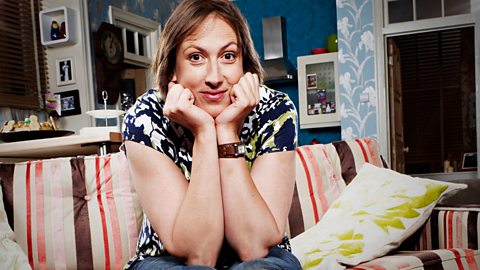
Image result for Miranda 
There are many points of recognition for middle class audiences in the ways in which the sitcom addresses audience’s lifestyles, concerns, hopes, such as Miranda's conflict with her mother as when Miranda’s mother is at first horrified that Miranda will be attending a social event afraid that she will embarrass herself and her mother. This may be relatable to mothers and daughters etc however afterwards she gave Miranda a boot camp in surviving the social occasions maybe relating to other middle class people and their struggles on social occasions. 
Another narrative strand that makes audiences relate to her is her trouble love life. To explain: Miranda’s love life has been mostly portrayed as non-existent except for a few hints at romance during that later seasons. However throughout all the seasons the strong friendship of the cook Gary and Miranda has been an important part of the show giving the audience an image of unrequited love where Miranda loves him but she is just a friend to him.   
Each episode also features predictable running gags such as Penny (Miranda’s mother) always saying “what I call” before a noun for example “what I call tennis”. This phrase: ‘what I call….’ Is used in every episode and creates a good laugh for the audience because of Miranda’s reaction of her predictably saying in annoyance “well it’s not just what you call tennis, everyone calls it tennis, it is tennis’. Miranda always manages to lose her clothing, such as in the episode when Miranda and the girls are at a formal social event and she gets hot so she decides to take of her sweater, which is over a blouse. However the sweater gets stuck on the blouse and she ends up taking off all her layers resulting in her standing in a very formal social event in her bra.
Stevie and Miranda always compete for boyfriends, such as the episode when a customer at the shop leaves his wallet behind also giving them insight into his life. With pictures of him, memberships to self-defence classes pictures of his dog etc. Stevie and Miranda begin a battle to win over the ‘wallet guy’ by buying dogs in hopes of seeing him in the park, attending the same self-defence classes he does and more. Miranda always embarrasses her friends socially, for example in an episode when she was again at a social occasion but UN interested in the conversation that was being had just joined in with the laughter whenever the woman finished a small part of the story. However when she turned away to get a glass of Champaign she failed to notice the subject changing to a man who had just passed and proceeded to turn back to the conversation and laugh.
The sitcom addresses audience’s lifestyles, concerns, hopes about relationships. Miranda always fails to explain her true feelings for Gary, such as when Miranda and the Clive are talking about Miranda telling Gary that she doesn’t want him to leave however when it comes down to it and Clive says ‘Miranda has something to tell you’  she chickens out and says: " And the horse just galloped off".
She competes with, quarrels and makes up with Stevie, for example when they are having a competition about who the wallet guy likes best and then they begin to fight over it because Stevie says that she has the allure that no man can resist but Miranda says that she herself may have the allure too. But in the end once the competition is done they make up. She gets scolded by her mother, such as in the episode when her mother says "just act normal", when Miranda isn’t doing anything but standing there.
Image result for Miranda and stevie fighting
Miranda shown lying down with Stevie (her best friend) looking disproving
In most sitcoms, the audience is passive consumer but this show is filmed before a live studio audience. In addition, Miranda establishes a relationship with her audience by beginning every episode by breaking the fourth wall and talking directly to them as well as doing this at small intervals throughout each episode. She confides in us, the audience her feelings, saying to Stevie: " I’ve been on loads of dates” and then turning to the audience and saying; “I’ve literally been on one”.
For Blumler and Katz, audiences use media to gratify needs (the uses and gratifications model of audience behavior). Miranda offers the pleasure of entertainment, escapism and diversion by making us laugh. In particular, both slapstick humor and verbal humor entertain us. Examples of these include Miranda constantly pushing Stevie onto the ground whenever she is annoying her showing slapstick humor or another example is when Miranda says: ‘ I am a smooth operator’ before promptly tripping over things on the floor and falling on her face. An example of verbal humor is when penny says to Miranda that she has to go to event and Miranda’s response is that she can’t because it’s her daughters first birthday when all the people there know very well that Miranda had no children.
Audiences also like to relate to the characters in programmes; I have shown that Miranda offers many points of recognition in its characters. Its also important that Miranda is a likeable character who does not hold grudges. For example whenever she is insulted by Stevie or her mum or friends she never holds it against them. It is also significant that Miranda Hart is a well-known British actress and comedian and even went onto the graham Norton show to promote her show.
Audiences tend to favor programmes that support their values and their sense of their own identity. Part of our sense of self is informed by making judgements about all sorts of people and things. This is also true of judgements we make about TV and film characters, and celebrities. The shows we watch, the stars we like can be an expression of our identities. One aspect of this type of gratification is known as value reinforcement. This is where we choose television programmes or newspapers that have similar beliefs to those we hold. Therefore, equally important is the upbeat, comic atmosphere of the show. Despite set-backs such as Stevie keeping her dog but pretending that she had given it back Miranda bounces back, for example, when she instinctively kept her dog in the kangaroo pouch.
Finally, audiences like to know what is going on in the world (surveillance). This relates to Maslow’s need for security. By keeping up to date with news about local and international events we feel we have the knowledge to avoid or deal with dangers. In a sitcom, the characters face all sorts of situations that we can experience vicariously, some of which are challenging, such as having to say goodbye to a loved one, keeping a strong emotion bottled up or dealing with constant criticism.
In conclusion, Miranda is a comedic sitcom based around the hysterical struggles of life. It is very relatable and attracts a wide audience of many age ranges because of the relatable aspects and topics that the show incorporates. It also appeals to more people because the audience are engaged more in the action because of being addressed to frequently. In my opinion this is a great show that always makes me laugh.

Friday, 7 October 2016

Matrix Introduction Analysis


This is an analysis of the matrix introduction where i will be talking about the mise en scene, editing, sound and camera work aswell as talking about my overall opinion of the piece. 

The opening of the matrix starts with green coding that fills the screen flashing and changing. The coding then slowly begins to fade away and morph into the title of the film: ‘The Matrix’. This title begins to get magnified (zoomed in) and more and more cropped before it disappears returning to the screen full of green coding. The reason that the green coding is constantly being used throughout the first few seconds of the film is that it really sums up or gives the audience a small idea of the main theme of the movie. In the background of the green coding a woman and a man are having a conversation on a phone, this helps a lot because it’s the first bit of dialogue we as audience members hears. The voice over really helps viewers to have an idea about the story line or plot of the movie.

Image result for matrixThe image then is focused on a flash light that, when using a panning shot, shows that it is being held by a man with a gun up and ready. The lighting in this scene is almost pitch black and the torches are the only source of light it would seem. The dark lighting and use of guns immediately tells you that straight of the bat in the intro there is something bad happening.  As the panning shot carries on it reveals several more flash lights searching the light further back in the shot and shows one of the men holding a flash light slowly come forward into the light. The man is wearing a police uniform and as all of the police men tentatively move forwards you can see by their surroundings that where ever they are it is has a sense of danger. Police men are seen, spread apart my 2 or 3 metre lined along the walls of a hall way positioned at either side of the screen creating a long empty path way. The police men that had been featured in the first image then begin to walk down this pathway guided by the light given from the lined up police officers. This shows that there is not just one or two policemen here: there are many, which hints to the viewer that the situation is dangerous and life threatening (also indicated by the use of guns). The police then enter a small room after kicking down a wooden door and enter to a woman sitting in a chair on the other side of the room facing away from the entering police. The woman has simple makeup but her hair is short and has been tightly slick back and her clothes are black. She has been made to look quite masculine. This room is again very dark and carries of the idea of danger.

The image then changes to a hotel sign with the letters of the name lit up however one of the letters was not lit up because the light had broken. They showed this to highlight the fact that they were not in a nice area because a hotel in a nice area would be embarrassed and able to quickly get it fixed. A fleet of police cars are shown with police men scattered around them. The image is still very dark however we are able to see the characters. The lights of the police cars are flashing in the background of the image as three men (not police) exit out of a car that just pulled up. All three of them are very well put together; There hair is slick back; they all have sunglasses on; they all are wearing expensive, fancy suits with a tie and they have ear pieces in. the scene is set showing the police of one side and these three men on the other however due to height, upright posture and there outfit, they seem to dominate. 
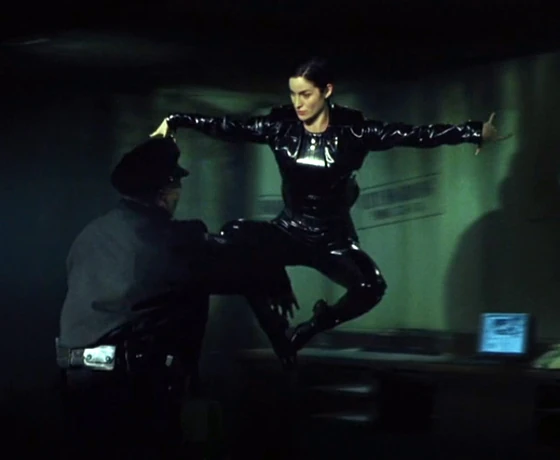
Image result for matrix high kick

The screen changes to the woman who is still standing facing the wall and away from the police squad behind her. Her hands are on her head as a man slowly edges towards her with handcuffs. She then whips around quickly before fighting the entire squad of police men in the room and defeating them. This shows that she is the best of the best and very good at her job or whatever her aim is in the film. A faced pace chase across roof tops is then carries out. Between the woman and the three put together men. However behind then is the police who are also chasing.

The sound effects start at the very begin where orchestral music is playing the background and is slowly building with the use of faced paced string instruments: violins and cellos etc. the music then fades away as the title of the film is shown. Coding noises: high pitched beeping noises and heard along with the electronic chattering of the numbers in the coding switching and changing. As the police men are shown in the scene the loud building music changes to soft, chilling, creepy high pitched music that creates tension and suspense and shows something bad is going to happen. In one scene one of the three tall, put together robot looking men turn his head to say:
‘oh lieutenant your men are already dead’, in reply to the lieutenant saying his men are going to be bringing the girl shortly. This implies that trinity (the girl) is very strong, beautiful heroin who can get past any obstacles. During the chase the music quickly begins to gain momentum. The speed increasing and the volume increasing creates a sense of acting, speed and danger. This building of the music carries on until the climax of the scene which is Trinity’s epic and impossible jump over the gap in-between two buildings. 

Diegetic sound is heard during the beginning in which the noise that the phone creates is heard during the falling coding and another example is when the guns were being fired when the fight scene was going on. 

During the first scene in which you see the police men a panning shot is used to alert the audience to the dark scary setting that the police are in. quite quickly afterwards a POV shot is used as a police man is kicking open the door. We, as the audience, are made to feel like the door as the police man is going to kick it down. We then see an upward panning shot onto trinities face with the police torch lights in the background which shows that she is cornered and outnumbered. A downwards pan is the used immediately after, in my opinion, showing that the scene that just occurred was high up and the scene that is about to occur is low down in the streets. 

Image result for matrix 3 agents
A crane shot is used to announce the entrance of the three mysterious men this was to show their power and intimidation over everyone else. An extreme close up is then used on trinities face however her face, on the right of the screen, as a policeman creeps towards her from behind. This shot and the fact that her eyes are clothes tells the audience that she is getting ready for something. Another crane shot is used once Trinity has defeated all the police men and is standing in the middle of their paralysed and pained bodies. This is to show authority and how powerful and dangerous she is and what she can do. The last crane shot in the intro is when trinity is doing her magical jump across the roof tops of a building in slow motions and we see trinity jumping and the enormity of the space in which she is jumping. We can also see the cars and streets bellows which is making you feel like you are there too but just above her. A bullet time photography shot is used next when Trinity is up in the air and performing a spectacular kick in slow motion. This shot really intensified the scene and the moment really highlighting trinity’s unique powers, strength and physical fitness.

Image result for matrixEditing in the scene starts out way before any of the characters have been introduced. During the beginning of the intro when the production company that produced the movie was being shown the screen was washed in a green colour so that everything was green. When the green coding then came onto the screen it created a nice fluid/sinister feel to the intro already. An editing program called superman echo created the cool falling coding at the beginning which gave the audience an idea that technology and hacking would be a part of the movie. During Trinities fight scene rapid cuts are used to create a fast paced, thrilling vibe to the scene. Gun noises are also used throughout this scene too. When trinity jumps over the huge gap between buildings it becomes slow motion which again is used during the scene in which trinity is up in air doing a kick. In both these scenes the use of slow motion create a magical sense to them. It highlights the awesome things that she is doing and it also tells the audience that she isn’t an ordinary person but is something slightly more special and powerful.

I really like this introduction. I think it gives a great insight into the rest of the movie: just enough so we understand what’s happening and want to see more but not enough so that we have seen too much and don’t want to watch the film. The film is definitely an action adventure and is very fast paced and the use of rapid cuts, building music and slow motion or fast paced chases fills the viewers with adrenaline.